With the new bidirectional DC wallbox, FENECON is opening the next chapter of e-mobility. While the FENECON Energy Management System (FEMS) acts as the central brain and the stationary home battery serves as the reliable heart of the home's energy supply, the new charging station brings an entirely new performance class to residential garages. It transforms the electric vehicle from a passive consumer into an active energy storage system.
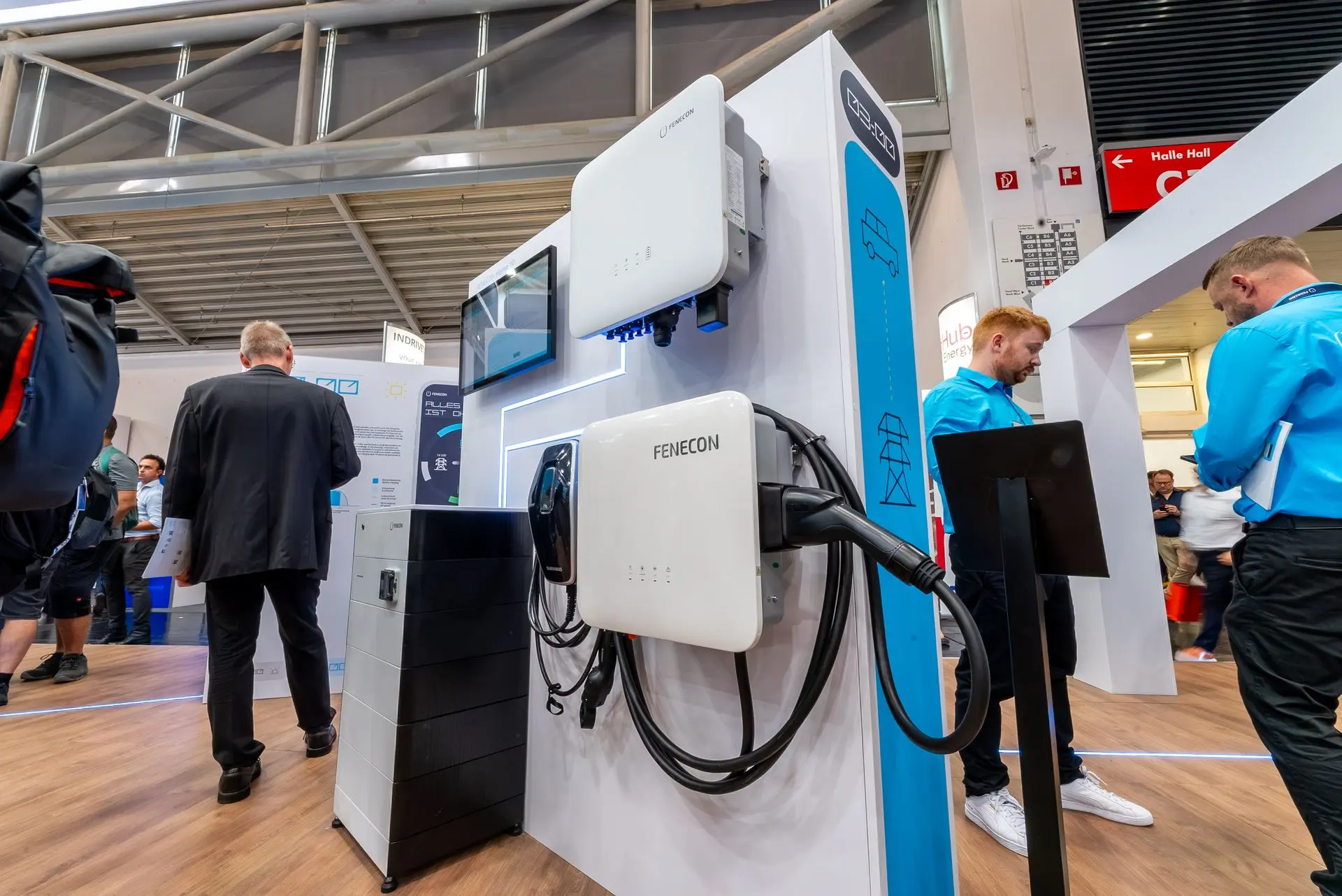
1. The Electric Vehicle as a Flexible Storage Extension
Bidirectional charging integrates the electric vehicle into the building's energy management system not only as a consumer but also as a potential power source, whether for directly supplying electricity to the household, the heat pump, or participation in the energy market.
An electric vehicle often remains unused for long periods. With battery capacities typically ranging from 50 to 100 kWh, it exceeds the capacity of conventional home storage systems (5 to 20 kWh) many times over. The new FENECON DC wallbox harnesses this potential and turns the vehicle into a massive mobile energy storage extension.
2. Why FENECON Consistently Chooses DC Instead of AC
Unlike the few available AC bidirectional charging solutions, FENECON consistently relies on DC (direct current). This approach offers practical technical and regulatory advantages:
No bureaucratic complexity:In AC systems, the inverter is located inside the vehicle. When electricity flows from the vehicle back into the home, the vehicle is legally and technically classified as a power generation unit under VDE-AR-N 4105. Until now, this has meant that every individual vehicle model, together with the wallbox, would require a complex and costly feed-in certification process. This regulatory dead end has forced some automotive manufacturers to limit their solutions to pure island-mode applications. In the FENECON DC wallbox, all power electronics are integrated into the charging station itself. The vehicle simply provides direct current. As a result, only the wallbox requires certification, regardless of the vehicle being used.
Up to 30 kW charging and discharging power:While AC wallboxes in residential applications are typically limited to 11 kW (and only rarely 22 kW), the FENECON DC wallbox delivers up to 30 kW of bidirectional power. This makes it possible to charge and discharge even large vehicle batteries in a very short time.
3. Vehicle Compatibility: Which Cars Are Supported?
There is no need to worry about choosing the right vehicle brand. The wallbox is compatible with all DC-chargeable electric vehicles. Any vehicle equipped with a CCS connector can be charged directly via DC.
4. Practical Applications: What Does This Look Like in Real Life?
In everyday operation, the wallbox functions as a high-performance tool fully controlled by FEMS.
Scenario A: The XXL Summer Buffer (Home Office & Second Vehicle)
When an EV spends the day at home, for example during remote work or as a family vehicle, it becomes a powerful extension of the home's energy storage capacity. The DC wallbox captures surplus solar power and stores it directly in the vehicle battery. In the evening, that energy can be used to run high-consumption household appliances, from air conditioning systems to pool pumps, or even to recharge a second EV returning from work.
Scenario B: The Winter Booster with Time-of-Use Tarifs
During the winter months, solar generation is limited, FEMS makes intelligent use of Time-of-Use Tariffs. Whenever electricity prices fall to their lowest levels, typically during the night when plenty of wind energy is available, the EV can be charged up to 30 kW. Later, when electricity is more expensive, that energy is available to support the home, powering everything from the heat pump to sauna on a cold winter evening. This helps reduce energy costs while making the most of every kilowatt-hour stored in the vehicle battery.
5. The Intelligence Behind It: FEMS & Smart Energy Plan
Even the most powerful hardware is only as good as the intelligence controlling it. That's where the FENECON Energy Management System (FEMS) comes in. Based on the open-source platform OpenEMS, it continuously coordinates every energy sector in the home, without vendor lock-in.
With Smart Events, users simply define the outcome they want, for example:
"Make sure my EV is charged to at least 50 kWh by 7:00 a.m." From there, FEMS takes care of the rest.
By combining weather forecasts, electricity market prices, time-variable grid fees and renewable energy curtailment signals, the system automatically determines the most cost-effective time to charge or discharge the vehicle.
Instead of constantly adjusting settings, homeowners can sit back while the system continuously optimizes itself.
At the same time, our digital assistant FENA provides full transparency, explaining exactly why the system is making a particular decision at any given moment. All energy management decisions are processed locally on the FEMS controller installed in your home, ensuring cybersecurity by design, while all FENECON servers are operated exclusively in Germany.
6. Who Can Benefit from the DC Wallbox?
The FENECON DC wallbox is designed to integrate seamlessly into a wide range of energy systems and can grow with future requirements.
Compatible with Existing Installations
The DC wallbox can already be integrated into existing systems, whether from FENECON or third-party manufacturers, via an AC-side connection for conventional EV charging.
Unlocking Its Full Potential with FENECON Gen 3
With the upcoming FENECON Gen 3 inverter platform, the wallbox will also support direct DC coupling. This is where the real magic happens: in combination with FEMS and intelligent energy scheduling, the system can fully optimise applications such as highly efficient surplus PV charging and Time-of-Use Tariffs.
An Added Benefit for System Design
The stationary residential battery storage system and FEMS will continue to serve as the heart and brain of the home's energy infrastructure, including maintaining backup power functionality. However, if an EV is regularly available during the day, whether because of remote working, flexible schedules or a second family vehicle, its battery can take on the role of a large solar energy buffer. In many cases, this reduces the need for an oversized stationary battery storage system.
The result: a more balanced system design and potentially lower investment costs without sacrificing flexibility. One factor should never be underestimated: inverter power.A properly sized inverter ensures that the entire energy system remains agile and ready to respond to changing market conditions. Whether taking advantage of favourable Time-of-Use Tariffs or rapidly charging and discharging the vehicle when required, system performance ultimately depends on the available inverter capacity. And, of course, the DC wallbox can only deliver its full 30 kW charging and discharging capability if the inverter is able to handle the same level of power.
Conclusion:
The new bidirectional FENECON DC wallbox closes the gap between electric mobility and smart energy management. Combined with intelligent FEMS energy scheduling, it transforms the EV from a means of transportation into a valuable energy asset, creating new opportunities to maximise self-consumption, reduce energy costs and increase flexibility. With up to 30 kW of bidirectional DC power, the vehicle effectively becomes the largest and most dynamic energy storage extension a homeowner can add to their system today.