At the grid connection point (GCP) of Jansen GmbH & Co. KG, several photovoltaic systems are already in place, currently configured for full feed-in to the grid. At the same time, the site has a continuous electricity demand of approximately 41,000 kWh per year.
As feed-in tariffs under Germany’s Renewable Energy Sources Act (EEG – Erneuerbare-Energien-Gesetz), which incentivize electricity fed into the grid from renewable sources, are gradually expiring, the economic viability of full feed-in is declining significantly.
The objective of the project was therefore to ensure the long-term economic use of the existing PV systems and to utilize the self-generated electricity as fully as possible within the company’s own operations.The focus was on maximizing on-site consumption through the intelligent integration of existing systems, future PV expansions, and a high-performance energy storage solution.
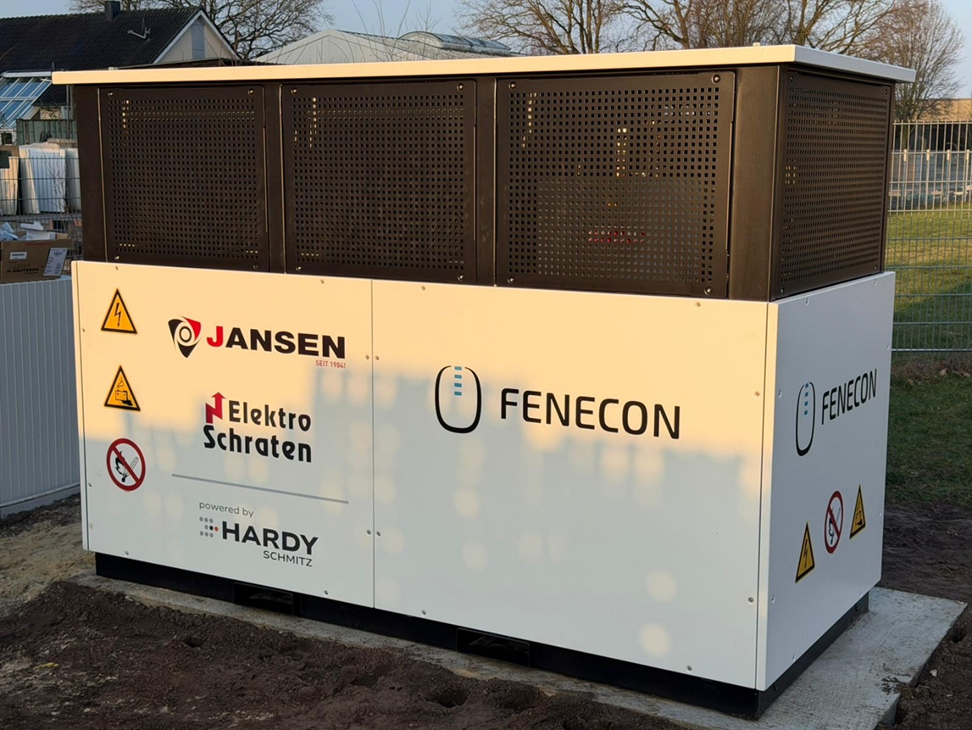
Client:
- Jansen GmbH & Co.KG
- Segment: Specialist retailer for forestry, gardening, and agricultural machinery
Installer:
- Elektro Schraten
Location:
- Emlichheim, Germany
Existing Assets:
- PV system: 378 kWp
- 99 kWp of PV capacity planned from 2027 onward
Implemented Solution:
- FENECON Industrial S
- Power: 184 kW
- Capacity: 164 kWh
Results:
- Increased self-consumption rate: Most of the generated solar energy is used directly on-site or temporarily stored in the battery system.
- Significantly reduced grid consumption: By utilizing self-generated energy, dependence on the electricity market is considerably reduced.
- Economical use of existing PV systems: Even after the end of EEG subsidies, the systems remain a valuable part of the energy supply. Currently, the feed-in tariff would amount to only around 2.4 ct/kWh.
- High level of energy autonomy: The combination of PV expansion and energy storage enables a largely self-sufficient energy supply at the site in the long term.
Conclusion:
Several smaller PV systems that will gradually exit the EEG subsidy scheme by 2030 are being integrated to optimize on-site consumption. This creates an energy system that combines economic and environmental benefits while making operations increasingly independent of rising electricity prices in the long term.